The day · walked through
Monday 9 November, in pictures
One day, in person, in the Lecture Hall of the Department of Journalism. Eight papers in four juxtapositions; between them, the room is made to wait. This is the whole day in order, as the room will live it. Times stay provisional.
Papers and wordsDevices of waitingTea and lunchHearing and close
The day, segment by segment
- 08:40
Officials' briefing ±20 min
About one in six of the room registered as government officials. They arrive early for a short briefing with the facilitator and receive a paper badge, a marker pen and a set of instruction cards they did not write.
- 09:00
Prologue · The door ±10 min
The advertised start passes and the door stays shut. A notice says it will begin shortly; chairs are provided. Those who wait queue and draw a numbered ticket, which becomes their name for the day. Friends and family walk straight in, holding the counterfoil of someone else's ticket. Presenters draw tickets too.
- 09:10
Opening frame ±10 min
The convenor names what the room has just felt — nobody apologised, nobody explained, nobody said when — and sets out the premise and the house rules: no question time, three positions, and a ticket turned face-down means you have stepped out.
- 09:20

I · A permit — June Luna ±30 min
Waiting in administrative and immigration law: the Home Affairs file that is never refused and never granted.
- 09:50

II · A novel — Dr Bo Lyu ±30 min
Ha Jin's Waiting and A Free Life beside Wang Jibing's delivery rider: a man made to wait, a man en route, and a man forbidden to wait.
- 10:20
Interlude · The ticket ±15 min
There is no question time, here or anywhere in the day. Questions are written on numbered slips, marked RECEIVED at the desk, and posted afterwards to the debate wall, where each presenter answers in writing.
- 10:35
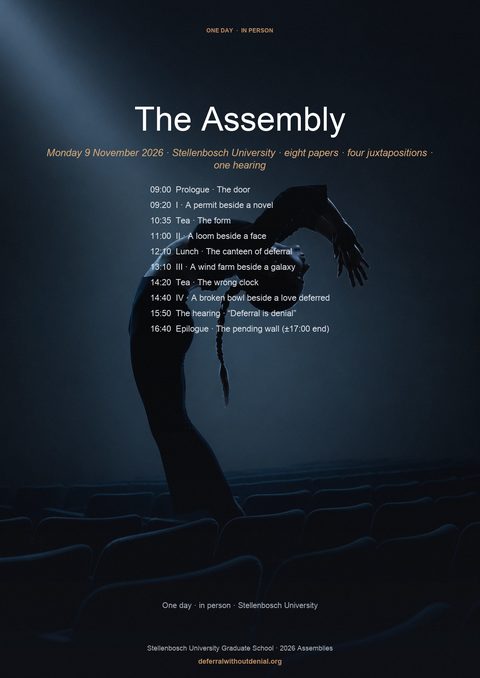
Tea · The form ±25 min
Morning tea is by application. An Application to Be Heard is filed at a slow desk; some forms come back DEFERRED, without reasons. What arrives is unlabelled. Declared dietary needs are met at a labelled table.
- 11:00

III · A loom — Dr Louise-Mari Muller ±30 min
I wait for “Noman”: Homer's Penelope and the heroism of staying behind, read with Ndebele and Eybers.
- 11:30

IV · A face — Dr Elysia Greenway ±30 min
Waiting to be named: forensic facial depiction, human identification and the time between. Content note: the paper concerns unidentified human remains and searching families; no graphic images are shown.
- 12:00
Interlude · The silent queue ±10 min
Ten minutes before a door marked OFFICE. No phones, no talk. Friends and family may watch but not join. The door opens on an empty room.
- 12:10

Lunch · The canteen of deferral ±60 min
Lunch opens late by design. Trays are issued by lot, not by place in the queue; dishes have numbers, not names; one table is set and never served. Allergen and religious requirements are met with labelled alternatives.
- 13:10
V · A wind farm — Dr Stephanie Borchardt ±30 min
The infrastructure does not wait: managed incompleteness and ecological harm on South Africa's renewable-energy frontier.
- 13:40

VI · A galaxy — Prof. Yin-Zhe Ma ±30 min
Light-travel delay and the early universe — when “too long to wait” is written into physics — and why most of a life is waiting.
- 14:10
Interlude · The register ±10 min
A clerk reads the register of questions received: numbers and status only, never the questions. Every status is PENDING.
- 14:20
Tea · The wrong clock ±20 min
Afternoon tea is announced for a time that slips, under a clock that is visible and wrong. The morning's deferred forms are served first, without explanation.
- 14:40

VII · A broken bowl — Jaco du Plooy ±30 min
To wait or not to wait? ‘Patience’ as a form of self-denial in Jeanne Benameur's La patience des traces.
- 15:10

VIII · A love deferred — Prof. Catherine Du Toit ±30 min
Henri-Pierre Roché's second novel: the impact of deferral on nascent love, captured through parallel juxtaposition.
- 15:40
Pause · The adjournment ±10 min
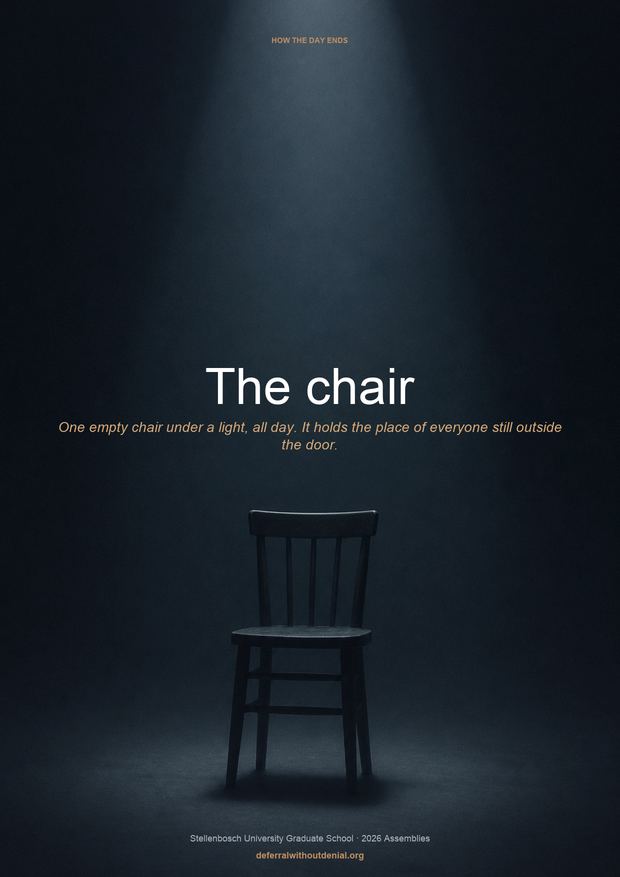
The room is reset as a hearing: three benches for the three positions, a row for the presenters as witnesses, one chair left empty. Nobody is told how long this will take.
- 15:50

The hearing · “Deferral is denial” ±35 min
The Assembly puts its own title on trial. Those who wait speak first, their friends and family second, the officials last — and only in the passive voice. The presenters sit as witnesses, not judges. Judgment is reserved.
- 16:25
Closing · The chair ±15 min
How the day ends with the empty seat is the closing argument.
- 16:40
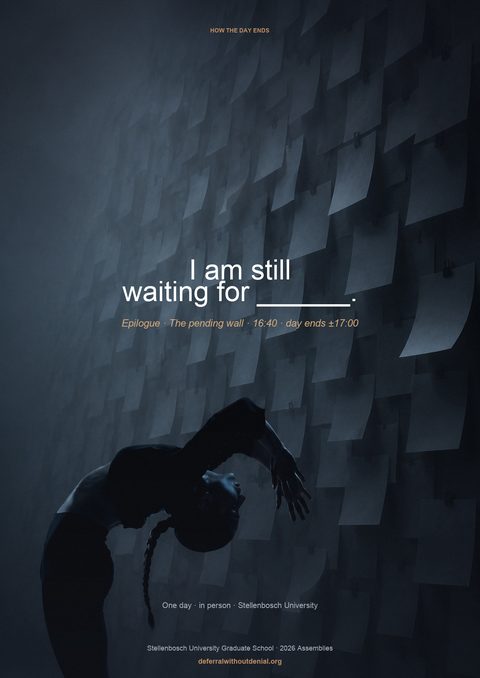
Epilogue · The pending wall ±20 min
The positions are dissolved. Officials hand in their badges, and everyone writes the same card: I am still waiting for ______. The reserved judgment is pinned beside them.
Four juxtapositions
The Assembly proceeds by juxtaposition rather than survey, on the wager that the comparison is itself the argument.
Juxtaposition I
A permit beside a novel
Waiting imposed by the state — and the home that is always still on the way.
- 09:20 · June Luna
- 09:50 · Dr Bo Lyu
Juxtaposition II
A loom beside a face
Those who stay behind — waiting for someone neither returned nor declared lost.
- 11:00 · Dr Louise-Mari Muller
- 11:30 · Dr Elysia Greenway
Juxtaposition III
A wind farm beside a galaxy
Waiting beyond the human scale — where those who wait cannot file a form.
- 13:10 · Dr Stephanie Borchardt
- 13:40 · Prof. Yin-Zhe Ma
Juxtaposition IV
A broken bowl beside a love deferred
Waiting chosen, and what it costs.
- 14:40 · Jaco du Plooy
- 15:10 · Prof. Catherine Du Toit
Three positions, one rule each
Anyone may step out at any moment by turning their ticket face-down, without explaining. Everyone is fed, whatever their form says.
The people who wait
You may ask. You may not be told.
Most of the room, presenters included. You draw the number, file the form, stand in the silent queue — and speak first at the hearing.
Their friends and family
You may ask for someone else. Never for yourself.
You hold the counterfoil of another person's ticket. You are served when they are deferred; you watch the queue you may not join.
The government officials
Never no, never why, never when.
About one in six. You hold the door, the desk and the register, follow an instruction card you did not write, and answer last, in the passive voice.
Nobody only watches. Register for a position by Friday 30 October.
Join the audience The programme · How the day is played · The debate wall · Rehearsal